Just kidding on that one, but we had to note that at least one reader saw fit to notify us that he was about to dive into our story from an altitude of about eight miles up.
Thanks for reading, Brent. And we couldn’t help but notice the snazzy Cleveland Cavaliers 2016 NBA championship jacket—a complementary and fitting accompaniment to the 1945 NFL champions.
Reader Brent Dohner: "Settling in with a good book for a 14-hour flight to Tokyo!" Thanks Brent, and Merry Christmas! pic.twitter.com/vdBfHmZkdg
It’s a question I don’t directly address in my book The Cleveland Rams, and yet, there it was posed to me via e-mail by Leciana “Lee” Gabor of Texas: What is the exact date that the Rams entered not the National Football League but the American Football League—their first home?
Turns out Lee’s son is a huge fan of the Los Angeles Rams, so she’s been doing some research on his behalf (what a great mom!). Lee wrote:
“The website is wonderful and, especially, the photos of the buildings important in the Cleveland Rams history.
“I have been searching for the exact date of the AFL franchise that Attorney Marshman and his friends established.
“I found in the building descriptions the date of the NFL franchise and previously had found that Mr. Marshman had met with Mr. Carr in Chicago in December, 1936, so was thrilled to find that date of 2-12-1937 for the actual franchise.
“Do you know the AFL franchise date? Please let me know one way or the other. I found the team schedule with games starting in October of 1936, but everything I find online simply says 1936 with no month or day.”
Homer H. Marshman and Damon “Buzz” Wetzel are forever united as co-founders of today’s Los Angeles Rams franchise.
A-ha! I’m pleased to report the Cleveland Rams’ entry to the American Football League can be pinpointed to … August 1, 1936. This was just six-and-a-half months before a near-championship in the AFL’s botched premiere season prompted the team to seek asylum in the more financially stable NFL. On that day the New York Times ran a small item reporting that “Harold D. Paddock, manager, said tonight the recently incorporated Cleveland Football Club would sponsor a Cleveland entry in the new American Professional League this Fall.”
But here’s where we run into a few wrinkles. It was not “Attorney Marshman”—i.e., Homer H. Marshman, widely and correctly considered to be one of the true fathers of the Rams and later a minority owner of the Cleveland Browns—who funded the endeavor. Instead it was the trio of Paddock, a gentleman named Reuel A. Lang, and the mysterious but equally important Damon “Buzz” Wetzel who were “incorporators of the Cleveland club.” As I take pains to note in my book, Buzz Wetzel is a somewhat tragic figure whose contributions as co-founder of today’s billion-dollar Rams franchise have been largely lost to history.
Here’s where I pick up the strand of the story in The Cleveland Rams. By September 6, just five weeks after gaining entry to the AFL, Wetzel announced that he had given up hope for the team due to “lack of sound financial backing.” Apparently Mssrs. Paddock and Lang were not up to the task.
But then, thanks to Paul Thurlow—owner of the competing Boston Shamrocks, and coincidentally a Harvard Law School classmate of Marshman’s—Wetzel gained access to a bevy of Cleveland money men including Marshman and newspaper magnate Dan Hanna. Newly infused with cash, the Rams were up and running, and while the rest of the AFL commenced play elsewhere, the Cleveland team hastily assembled a roster that included Wetzel as player-coach and future Pro Football Hall of Famer Sid Gillman at end. The team conducted practice at a Cleveland-area golf course, then on October 11, 1936, the Rams franchise debuted to the world at Cleveland’s League Park with a 26–0 shutout of the Syracuse Braves.
Though Marshman and Wetzel are forever linked as co-founders of the Rams, they came to different ends.
Marshman was a member of the Cleveland consortium that sold the Rams in 1941 to New Yorker Daniel F. Reeves, who ultimately moved the franchise to L.A. Twenty years later Marshman again was a member of a consortium, this time selling the Browns to New Yorker Arthur B. Modell, who ultimately moved that team to Baltimore—thereby achieving the singular distinction of having sold not one but two NFL franchises to out-of-towners who eventually moved them out of Cleveland. Not that this seemed to trouble Marshman much. Wealthy and a member of high society, he in the fullness of time moved to Palm Beach, Florida, where he died in 1989—a half-dozen years before Modell transferred the Browns.
In contrast, Wetzel was fired as Rams general manager by Marshman & Company in 1938 after the team lost 11 of its first 12 games in the NFL. He drifted into minor league baseball, served in the Navy in World War II, and died in Texas in 1985. After the Rams released him, he never held another position in pro football.
Where: Central Armory, at the corner of Lakeside Avenue and East 6th Street in downtown Cleveland.
Why: Site of the Washington Redskins’ “brief workout” just before the 1945 NFL championship game.
Now: The Armory was demolished in 1965 and replaced by a plaza adjacent to the Anthony J. Celebrezze Federal Building.
What: The Washington Redskins arrived by train with owner George Preston Marshall and their 120-piece marching band the day before the title game, intending to practice on an available open field somewhere in Cleveland, possibly at Baldwin Wallace College. “But they evidently don’t understand,” wrote the Plain Dealer’s John Dietrich, “that for the moment the local landscape looks like that of the North Pole.” Instead the Redskins were forced indoors to a “cavalry stable” just up a lakefront slope from Cleveland Municipal Stadium. There they went through a “brief workout” on December 15, 1945. They would have no such sanctuary the next day, however, as the elements would play a key role and lead to their undoing in their fateful championship-game matchup with the Cleveland Rams.
Why: Site of the Cleveland Rams’ practices the week before they won the 1945 NFL championship.
Now: Fairhill Place Apartments at the corner of Fairhill and Kemper roads in Shaker Heights, Ohio.
What: The weather was so cold and snowy leading up to the 1945 NFL championship game that the Rams had to set up camp in this brick-and-steel, two-story armory in suburban Shaker Heights in order to conduct their practices. “How do you like this spot?” star quarterback Bob Waterfield was asked by a newspaper reporter. “Can’t kick,” the always-laconic Waterfield replied, “but, otherwise, it’s all right.”
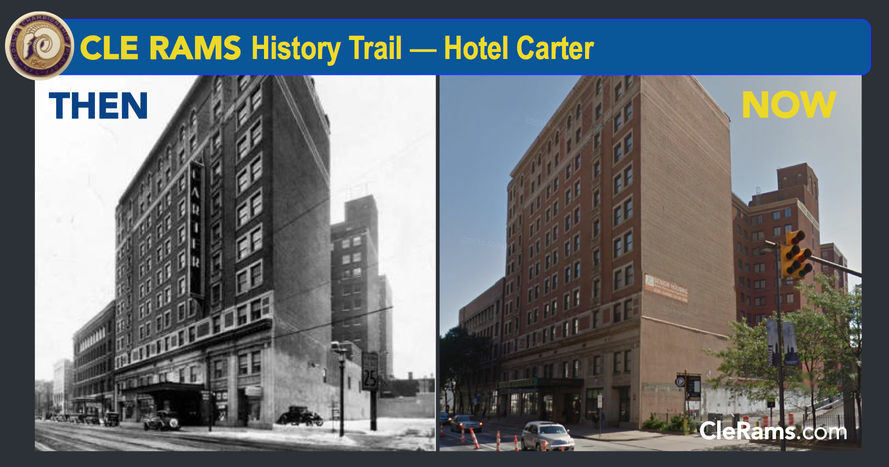
Why: The only public celebration of the Rams’ unexpected success in Cleveland was held in this hotel’s swanky Rainbow Room, whose chef at one time was Ettore “Hector” Boiardi—later immortalized as “Chef Boyardee.”
Now: The building is still remarkably intact at 1012 Prospect Avenue in Cleveland, though known now as Winton Manor, an apartment building for seniors.
What: It was December 12, 1945—snowy in Cleveland, and bitter cold—and precisely one month later the Rams would forsake the city for L.A. But the more than 800 team managers and players, civic leaders, and fans who packed the room for a “testimonial dinner” had no inkling (save, perhaps, for owner Daniel F. Reeves and general manager Charles “Chile” Walsh) of the future that awaited the team in the West. All they knew was that in four days the Rams would meet the Washington Redskins for the 1945 NFL championship. Head coach Adam Walsh, older brother of Chile, assured the raucous assembly that his players would be ready to play even if they had to play on “skates, skis, or sleds!”
Why: Bob Waterfield and Jane Russell lived here in the autumn of 1945
Now: Demolished. Replaced by new housing at 8205 Euclid Avenue, Cleveland, just west of Cleveland Clinic’s now-sprawling campus.
What: Waterfield and his new wife, movie star Jane Russell, were immediate—if brief—sensations in Cleveland when they alighted here in 1945. Both newly wealthy from their booming careers, they took up residence in this eight-story brick edifice that at one time had been a grand home to residents including a Rockefeller of the Standard Oil Company and the president of the old Cleveland Spiders pro baseball team. But since then, the building had been remodeled into apartments, and Waterfield and Russell shared a humble pull-down bed and cooked on a “tiny stove on top of the fridge” as they slowly grew homesick for their native southern California.
In late October 1945 the Rams’ PR rep received a request from LIFE magazine to publish a story about the couple. Russell’s movie studio initially was hesitant to provide permission, fearful of exposing the sex symbol’s marital status, but Russell was game. “I’ll cooperate with you on anything that’s good for Robert and (the) Rams,” she told him. A photographer arrived to capture the couple at home in the St. Regis and at League Park, with Russell at the latter daringly holding a staged placekick for her fully uniformed husband. The celebrity duo and their homespun lifestyle in Cleveland would be introduced to a national audience in the LIFE issue dated December 17, 1945—the day after the Rams had been crowned world champions.
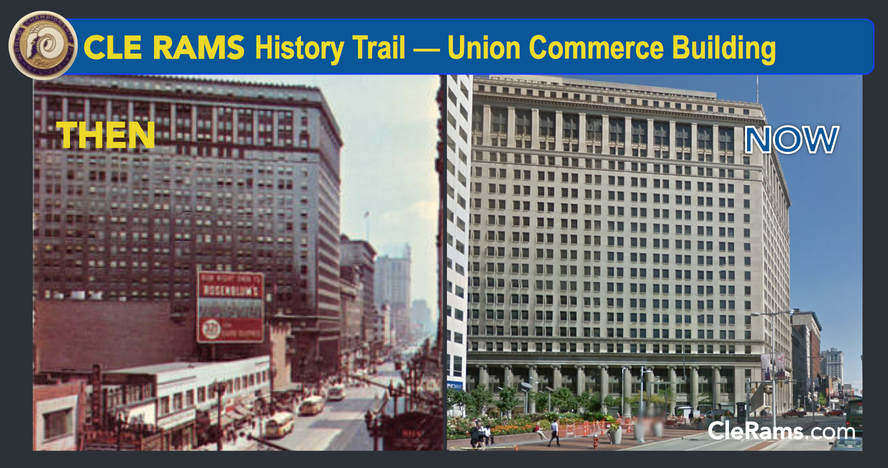
Why: Business operations for the fledgling Rams franchise rotated around this commanding building at Cleveland’s business crossroads: East Ninth Street and Euclid Avenue.
What: Rams co-founder and lawyer Homer H. Marshman amassed paperwork pertaining to the new franchise in a “neat and orderly folder” in his desk drawer while working from an office here in 1936. New Yorker Daniel F. Reeves operated out of this location on his infrequent trips to Cleveland after he bought the team in 1941. And it was from here that Rams general manager Charles “Chile” Walsh conducted scouting and recruitment efforts during World War II that ultimately built the franchise’s 1945 NFL championship team and the franchise’s greatest sustained stretch of football success to this day.
Why: The Rams played 19 of their 41 AFL and NFL home games here while they were in Cleveland, including all four of their regular-season contests leading up to their 1945 NFL championship.
What: Though home to baseball’s Cleveland Indians, League’s Park rectangular configuration and seating capacity of 23,000 made it a surprisingly accommodating facility for football—professional as well as collegiate. Located at a trolley stop at the corner of Lexington Avenue and East 66th Street, League Park was sewn into the middle of the Hough neighborhood on the city’s East Side, with automobile parking accommodated—for a small fee, of course—by local residents and their shallow front yards. The final two NFL games there were particularly momentous. On November 11, 1945 a flash overflow crowd of 28,361 jammed into the park’s grandstands as well as a battalion of temporary bleachers erected along the right-field wall, causing the latter to collapse and injure 31—though many joyous fans engrossed in the Rams’ 20–7 victory over the hated Green Bay Packers hardly noticed. At League Park’s very last football game, on December 2, 1945, the Western Division champion Rams ran their record to 9–1 by defeating the Boston Yanks, 20–7, before 18,470. Boxing legend Jack Dempsey was on hand to help celebrate a special “day” for fan favorite, lineman Riley “Rattlesnake” Matheson. Just six weeks later, Rams owner Daniel F. Reeves announced the team was moving west to become the Los Angeles Rams.
Why: The Rams hosted two regular-season games here in 1938
Now: Still located at 14305 Shaw Avenue, East Cleveland, though now painted in the black-and-red of the Shaw High School Cardinals rather than the white of 1938
What: Nothing seemed to better symbolize the Rams’ futility in their early years than their sharing of Shaw Stadium in East Cleveland, if only briefly, with the Shaw High School Cardinals. Yet the Rams’ decision to host two games there in 1938—a 7–6 loss to the Chicago Cardinals on September 17, and a 21–17 victory over the Detroit Lions on October 2—made some sense. Shaw Stadium just had been renovated and enlarged and was lavishly maintained, off limits to high-school practices but available for game-day use by colleges and other high schools. The stadium furthermore was among the best illuminated in Ohio, its lighting designed and installed by General Electric, whose NELA Park, one of the nation’s first planned industrial research facilities, was just a mile-and-a-half away. And its 15,500 capacity was well suited to the team’s small but growing fan base. But by October 9, 1938 the team had returned to the fifty-percent-larger League Park for a stunning 14–7 upset of the Chicago Bears, and the Rams—and NFL football—never returned to Shaw Stadium.





 THE CLEVELAND RAMS