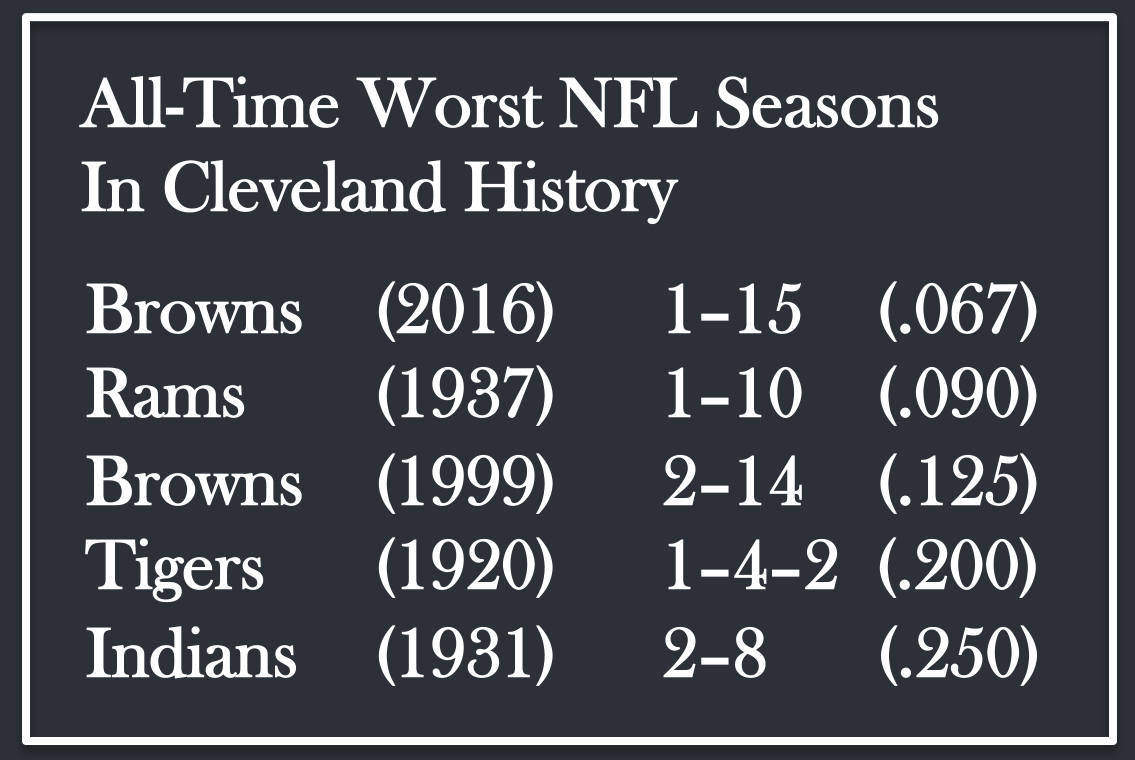
Until 2016, the answer would have been yes. In 1937 the debut edition of the Cleveland Rams and their 0–10 (.090) record put in a performance of on-field futility that surpassed even the inaugural Cleveland Browns II of 1999 (2–14, .125).
And then along came the Browns of 2016 and their 1–15 (.067) record.
Yes, Cleveland football fans—not just Browns fans but fans of all Cleveland NFL teams through the decades—have never seen an NFL season more awful than the one they’ve just witnessed. And that’s saying a lot.
You see, Cleveland was a charter member of the American Professional Football Association (APFA) all the way back in 1920—just shy of a century ago. We now know the APFA as the National Football League, born of man in that famous manger Hupmobile dealership in Canton, Ohio; and believe it or not, it actually took some time for NFL football to take hold in what was then baseball- and boxing- and college-football-mad Cleveland.
Hugo Bezdek was a fantastic Major League Baseball manager and college football coach, but as the head coach of the 1937-1938 Cleveland Rams he was an abject failure. He was fired after compiling a 1–13 record and never coached pro football again.
Three NFL teams predate the Rams and the Browns in Cleveland: an NFL charter franchise called first the Tigers then the Indians in 1920 and 1921; a Canton Bulldogs / Cleveland Indians blend (1923-1927) newly christened the Cleveland Bulldogs in time to become NFL champs in 1924; then, for one single season that was underwritten by the league in hopes of getting something started in Cleveland, a second version of the Indians. But that team was was disbanded after compiling a 2-10 record, thereby qualifying it for fifth on Cleveland’s all-time infamy list.
In terms of losing percentages the 2016 Browns have beaten ’em all—the debut rosters of four different expansion teams included.
Optimistic Browns fans might choose to derive some hope from the Rams’ rags-to-riches story. And it is indeed true that after cycling through four head coaches and turning over their entire roster between 1937 and 1944, the Rams dove deep into the 1944 NFL draft and selected, with the 42nd overall pick, a dark-horse quarterback out of UCLA who hadn’t even earned All-American status. The very next season, 1945, Bob Waterfield passed the Rams to a 9–1 record and the NFL championship.
The Browns can only hope the 2017 player draft in April brings much the same result. They currently hold the number-one pick.
Take heart, Cleveland. As the new book “The Cleveland Rams” recounts, the city’s previous all-time losers went from worst to first in seven seasons.
January 8, 2017 | Cleveland —For 79 years, the 1937 Cleveland Rams and their 1–10 record (.090) stood as an exemplar of futility for NFL football in Cleveland.
No more. The Browns’ just-completed 1–15 season (.067) not only is the worst for the franchise, it also set an all-time new low among Cleveland NFL franchises dating back nearly 100 years.
Yet for the historically minded football fan, the Rams and their turnaround should offer some hope.
Admitted to the NFL as an expansion team, the Rams did even worse in their inaugural year than did the Browns of 1999 (2–14, .125). To make matters worse, they started the following season by going 0–3. It was a dismal 1–13 beginning for today’s L.A. Rams franchise.
But then in just seven seasons pockmarked by World War II, the Rams went from worst to first, winning the 1945 NFL Championship Game at Cleveland Municipal Stadium behind Bob Waterfield, who to this day is the only quarterback ever to win an NFL title in his rookie year.
Yet even then, there was a very Cleveland-like reversal of fortune. Only 27 days after the title game, Rams owner Daniel F. Reeves announced he was transferring his franchise to L.A. under circumstances not unlike Art Modell’s move of the Browns to Baltimore precisely 50 years later.
Cleveland-area author James C. Sulecki recounts these astounding stories and others in his newly published football history book,The Cleveland Rams: The NFL Champs Who Left Too Soon, 1936–1945(McFarland, 2016)—the first full accounting of the origins of today’s billion-dollar Rams franchise in 1930s and 1940s industrial Cleveland. It’s a story whose tragedies and lessons still resonate today.
It’s a question I don’t directly address in my book The Cleveland Rams, and yet, there it was posed to me via e-mail by Leciana “Lee” Gabor of Texas: What is the exact date that the Rams entered not the National Football League but the American Football League—their first home?
Turns out Lee’s son is a huge fan of the Los Angeles Rams, so she’s been doing some research on his behalf (what a great mom!). Lee wrote:
“The website is wonderful and, especially, the photos of the buildings important in the Cleveland Rams history.
“I have been searching for the exact date of the AFL franchise that Attorney Marshman and his friends established.
“I found in the building descriptions the date of the NFL franchise and previously had found that Mr. Marshman had met with Mr. Carr in Chicago in December, 1936, so was thrilled to find that date of 2-12-1937 for the actual franchise.
“Do you know the AFL franchise date? Please let me know one way or the other. I found the team schedule with games starting in October of 1936, but everything I find online simply says 1936 with no month or day.”
Homer H. Marshman and Damon “Buzz” Wetzel are forever united as co-founders of today’s Los Angeles Rams franchise.
A-ha! I’m pleased to report the Cleveland Rams’ entry to the American Football League can be pinpointed to … August 1, 1936. This was just six-and-a-half months before a near-championship in the AFL’s botched premiere season prompted the team to seek asylum in the more financially stable NFL. On that day the New York Times ran a small item reporting that “Harold D. Paddock, manager, said tonight the recently incorporated Cleveland Football Club would sponsor a Cleveland entry in the new American Professional League this Fall.”
But here’s where we run into a few wrinkles. It was not “Attorney Marshman”—i.e., Homer H. Marshman, widely and correctly considered to be one of the true fathers of the Rams and later a minority owner of the Cleveland Browns—who funded the endeavor. Instead it was the trio of Paddock, a gentleman named Reuel A. Lang, and the mysterious but equally important Damon “Buzz” Wetzel who were “incorporators of the Cleveland club.” As I take pains to note in my book, Buzz Wetzel is a somewhat tragic figure whose contributions as co-founder of today’s billion-dollar Rams franchise have been largely lost to history.
Here’s where I pick up the strand of the story in The Cleveland Rams. By September 6, just five weeks after gaining entry to the AFL, Wetzel announced that he had given up hope for the team due to “lack of sound financial backing.” Apparently Mssrs. Paddock and Lang were not up to the task.
But then, thanks to Paul Thurlow—owner of the competing Boston Shamrocks, and coincidentally a Harvard Law School classmate of Marshman’s—Wetzel gained access to a bevy of Cleveland money men including Marshman and newspaper magnate Dan Hanna. Newly infused with cash, the Rams were up and running, and while the rest of the AFL commenced play elsewhere, the Cleveland team hastily assembled a roster that included Wetzel as player-coach and future Pro Football Hall of Famer Sid Gillman at end. The team conducted practice at a Cleveland-area golf course, then on October 11, 1936, the Rams franchise debuted to the world at Cleveland’s League Park with a 26–0 shutout of the Syracuse Braves.
Though Marshman and Wetzel are forever linked as co-founders of the Rams, they came to different ends.
Marshman was a member of the Cleveland consortium that sold the Rams in 1941 to New Yorker Daniel F. Reeves, who ultimately moved the franchise to L.A. Twenty years later Marshman again was a member of a consortium, this time selling the Browns to New Yorker Arthur B. Modell, who ultimately moved that team to Baltimore—thereby achieving the singular distinction of having sold not one but two NFL franchises to out-of-towners who eventually moved them out of Cleveland. Not that this seemed to trouble Marshman much. Wealthy and a member of high society, he in the fullness of time moved to Palm Beach, Florida, where he died in 1989—a half-dozen years before Modell transferred the Browns.
In contrast, Wetzel was fired as Rams general manager by Marshman & Company in 1938 after the team lost 11 of its first 12 games in the NFL. He drifted into minor league baseball, served in the Navy in World War II, and died in Texas in 1985. After the Rams released him, he never held another position in pro football.
Where: Central Armory, at the corner of Lakeside Avenue and East 6th Street in downtown Cleveland.
Why: Site of the Washington Redskins’ “brief workout” just before the 1945 NFL championship game.
Now: The Armory was demolished in 1965 and replaced by a plaza adjacent to the Anthony J. Celebrezze Federal Building.
What: The Washington Redskins arrived by train with owner George Preston Marshall and their 120-piece marching band the day before the title game, intending to practice on an available open field somewhere in Cleveland, possibly at Baldwin Wallace College. “But they evidently don’t understand,” wrote the Plain Dealer’s John Dietrich, “that for the moment the local landscape looks like that of the North Pole.” Instead the Redskins were forced indoors to a “cavalry stable” just up a lakefront slope from Cleveland Municipal Stadium. There they went through a “brief workout” on December 15, 1945. They would have no such sanctuary the next day, however, as the elements would play a key role and lead to their undoing in their fateful championship-game matchup with the Cleveland Rams.
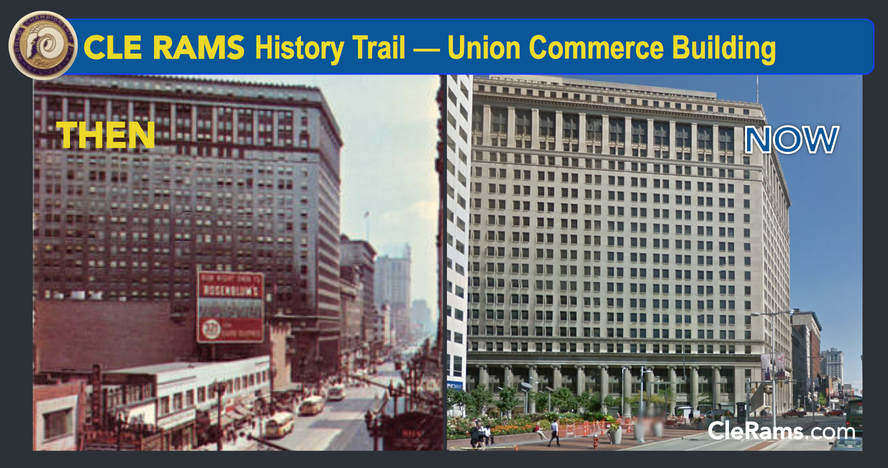
Why: Business operations for the fledgling Rams franchise rotated around this commanding building at Cleveland’s business crossroads: East Ninth Street and Euclid Avenue.
What: Rams co-founder and lawyer Homer H. Marshman amassed paperwork pertaining to the new franchise in a “neat and orderly folder” in his desk drawer while working from an office here in 1936. New Yorker Daniel F. Reeves operated out of this location on his infrequent trips to Cleveland after he bought the team in 1941. And it was from here that Rams general manager Charles “Chile” Walsh conducted scouting and recruitment efforts during World War II that ultimately built the franchise’s 1945 NFL championship team and the franchise’s greatest sustained stretch of football success to this day.
What: The Rams’ beginnings as an entity in the National Football League originated here. Owners Homer H. Marshman and Dan Hanna, frustrated with the financial struggles and general second-rate operation of the American Football League, met for lunch here at the end of the Rams’ 1936 inaugural season to discuss whether to stay in the AFL. “Count me out,” Marshman told Hanna; the AFL, he said, was “a failure.” Instead the two men called Joe F. Carr—Columbus, Ohio, native and president of the NFL—who encouraged the Rams to apply for entry. A few months later, on February 12, 1937, the Cleveland Rams officially joined the NFL.
Why: In 1936 the team’s owners gathered here for lunch every Monday after a game to tote up team expenses and chip in cash to keep the team afloat
Now: Located at 105 Euclid Avenue, Cleveland. The building currently is unoccupied except for some retail at street level (the store closed in 1993) but is scheduled to be converted to apartments
What: In the summer of 1936 the Rams franchise was set to begin play in the American Football League—coincidentally just as the Republican National Convention was held in the city. One of the team’s founding owners was Robert H. Gries, operating manager of the May Company and later a founder of the Cleveland Browns with Arthur “Mickey” McBride. Every Monday after each game, Gries hosted the other owners for lunch, at which they would add up on a paper napkin all of the week’s expenses, reach in their pockets, and pool their money. “I mean, it was very primitive,” said Gries’s son Robert D. Gries, long-time minority owner of the Cleveland Browns, but it pulled the franchise through its all-important first year in the post-Depression era.
Why: Working from here as a sportswriter for the Cleveland Plain Dealer, John Dietrich was instrumental in the naming of the Rams
Now: Louis Stokes Wing of the Cleveland Public Library, 525 Superior Avenue, Cleveland
What: Cater-corner from the Hollenden Hotel were the offices of the Cleveland Plain Dealer, where sportswriter John Dietrich covered, encouraged, and excoriated the Rams during their 10-year stay in Cleveland. He was present at the christening of the franchise, suggesting that the four-letter brevity of “Rams” would fit nicely into a newspaper headline. With the team still in town, Dietrich accepted the company one evening of new All-America Football Conference owner Arthur “Mickey” McBride, who asked Dietrich to recommend a candidate to coach his new team. Easy, Dietrich said—Ohio State coach Paul Brown. The franchise became the Cleveland Browns, and hastened the Rams’ departure to L.A.
What: The Rams franchise probably would not be here today had the American Professional Football Association not been founded in Canton, Ohio in 1920, then changed its name to the National Football League at an owners meeting at Cleveland’s Hollenden Hotel on June 18, 1922. The new NFL moniker was championed by Chicago Bears founder George Halas, who thought “professional” was “superfluous” and that the term “association” connoted second-division baseball. “And we were first class,” he said. The NFL, destined to be called “America’s Game,” was underway …

 Yes, Cleveland football fans—not just Browns fans but fans of all Cleveland NFL teams through the decades—have never seen an NFL season more awful than the one they’ve just witnessed. And that’s saying a lot.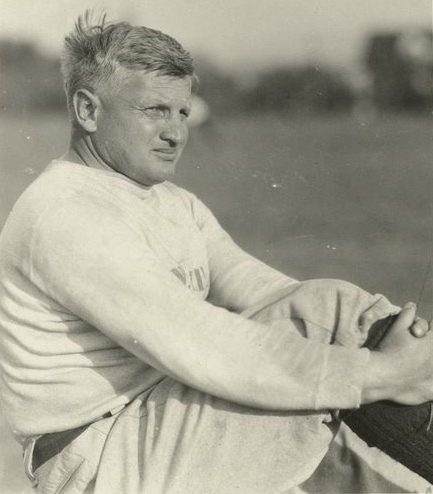




 THE CLEVELAND RAMS