Rams History Trail >> Union Club of Cleveland

Union Club of Cleveland

Where: Union Club of Cleveland

Why: One of the oldest social organizations in the city of Cleveland and gathering place for many of the Rams founding investors

Now: Still located at 1211 Euclid Avenue, Cleveland

WhatThe Rams’ beginnings as an entity in the National Football League originated here. Owners Homer H. Marshman and Dan Hanna, frustrated with the financial struggles and general second-rate operation of the American Football League, met for lunch here at the end of the Rams’ 1936 inaugural season to discuss whether to stay in the AFL. “Count me out,” Marshman told Hanna; the AFL, he said, was “a failure.” Instead the two men called Joe F. Carr—Columbus, Ohio, native and president of the NFL—who encouraged the Rams to apply for entry. A few months later, on February 12, 1937, the Cleveland Rams officially joined the NFL.

<< May Company department store

Shaw Stadium >>

Rams History Trail >> May Company Department Store

May Company.Rams history trail

Where: May Company department store

Why: In 1936 the team’s owners gathered here for lunch every Monday after a game to tote up team expenses and chip in cash to keep the team afloat

Now: Located at 105 Euclid Avenue, Cleveland. The building currently is unoccupied except for some retail at street level (the store closed in 1993) but is scheduled to be converted to apartments

WhatIn the summer of 1936 the Rams franchise was set to begin play in the American Football League—coincidentally just as the Republican National Convention was held in the city. One of the team’s founding owners was Robert H. Gries, operating manager of the May Company and later a founder of the Cleveland Browns with Arthur “Mickey” McBride. Every Monday after each game, Gries hosted the other owners for lunch, at which they would add up on a paper napkin all of the week’s expenses, reach in their pockets, and pool their money. “I mean, it was very primitive,” said Gries’s son Robert D. Gries, long-time minority owner of the Cleveland Browns, but it pulled the franchise through its all-important first year in the post-Depression era.

<< Newsroom of the Plain Dealer

Union Club of Cleveland >>

Author to Recast the Legacy of Cleveland’s, and the NFL’s, Most Forgotten Champions

The Cleveland Rams won an unexpected NFL title in 1945 and moved 27 days later—and for reasons that will reshape the historical narrative about today’s L.A. Rams

July 5, 2016  |  Mentor, Ohio — James C. Sulecki, author of the forthcoming book The Cleveland Rams: The NFL Champs Who Left Too Soon, 1936–1945 (McFarland & Company, $35.00), has used deep archival research to set straight a story that has haunted many Cleveland sports fans for three-quarters of a century: Why and how the pro football team could leave the city only 27 days after winning the 1945 championship.

The reasons were far more complex than the start-up of the new Cleveland Browns of the All-America Football Conference, Sulecki learned. The Rams were gelling rapidly as an organization, support for the team was galvanizing in the city, and Cleveland fans fully expected to enjoy watching not one but two winning pro football teams in 1946. But then young Rams owner Daniel F. Reeves pressured his fellow NFL owners into granting permission to do something he had intended from the moment he bought the team five years earlier: move it to another city.

Turmoil and enduring change erupted in the wake of Reeves’s decision even as a citywide newspaper strike muffled public reaction in Cleveland. The Rams wandered from Cleveland to Los Angeles to Anaheim and then to St. Louis. And now as the rootless Rams settle back in Los Angeles this autumn to begin another chapter, “the timing of the book’s publication couldn’t be more ideal,” Sulecki said. “Fans of the team and of the NFL in general never will see today’s Rams franchise in the same light again.”

McFarland & Company has set an October 2016 release for The Cleveland Rams. Print and e-book editions will be available online through Amazon, Barnes & Noble, and IndieBound and through the publisher’s website at www.mcfarlandbooks.com.

Rams History Trail >> Newsroom of the Plain Dealer

Cleveland Plain Dealer newsroom

Where: Cleveland Plain Dealer newsroom

Why: Working from here as a sportswriter for the Cleveland Plain Dealer, John Dietrich was instrumental in the naming of the Rams

Now: Louis Stokes Wing of the Cleveland Public Library, 525 Superior Avenue, Cleveland

What: Cater-corner from the Hollenden Hotel were the offices of the Cleveland Plain Dealer, where sportswriter John Dietrich covered, encouraged, and excoriated the Rams during their 10-year stay in Cleveland. He was present at the christening of the franchise, suggesting that the four-letter brevity of “Rams” would fit nicely into a newspaper headline. With the team still in town, Dietrich accepted the company one evening of new All-America Football Conference owner Arthur “Mickey” McBride, who asked Dietrich to recommend a candidate to coach his new team. Easy, Dietrich said—Ohio State coach Paul Brown. The franchise became the Cleveland Browns, and hastened the Rams’ departure to L.A.

<<  Damon “Buzz” Wetzel’s house

May Company department store >>

Rams History Trail >> Hollenden Hotel

Cleveland Rams, Hollenden Hotel

Where: The Hollenden Hotel

Why: The National Football League as we know it began here

Now: Fifth Third Bank Building, 600 Superior Avenue, Cleveland

What: The Rams franchise probably would not be here today had the American Professional Football Association not been founded in Canton, Ohio in 1920, then changed its name to the National Football League at an owners meeting at Cleveland’s Hollenden Hotel on June 18, 1922. The new NFL moniker was championed by Chicago Bears founder George Halas, who thought “professional” was “superfluous” and that the term “association” connoted second-division baseball. “And we were first class,” he said. The NFL, destined to be called “America’s Game,” was underway …

<<  Rams History Trail

Home of Damon “Buzz” Wetzel >>

Rams History Trail >> Damon “Buzz” Wetzel’s House

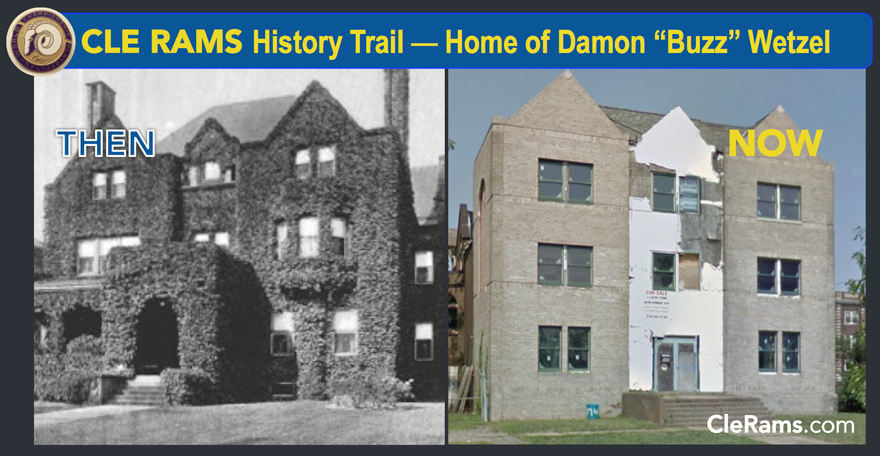
Damon "Buzz" Wetzel house, Cleveland

Where: Home of Damon “Buzz” Wetzel

Why: The true founder of the Rams franchise lived here while coaching the team in its inaugural season of 1936

Now: A semi-rehabbed but abandoned residence at 7609 Euclid Avenue, Cleveland

What: The founding of the Rams usually is attributed to lawyer-businessman Homer H. Marshman, and indeed it was at Marshman’s house in the exclusive Cleveland suburb of Waite Hill that funding was lined up to launch the team in the American Football League in 1936. But it was young Damon “Buzz” Wetzel—barely out of The Ohio State University, son of a Cleveland Indians scout, and with one season under his belt as an NFL player for the Chicago Bears and Pittsburgh Pirates (now Steelers)—who prevailed on Marshman and other Cleveland moneymen to invest. Wetzel recruited future Hall-of-Fame coach Sid Gillman to play for the Rams, became the team’s first head coach, and served as its general manager when the team entered the NFL in 1937. In 1938 he was pushed out by many of the same investors he had brought in and never worked in the NFL again.

<<  Hollenden Hotel

Newsroom of the Plain Dealer  >>